Beyond Volatility: The Tricky Choices Ahead on Energy Costs

Even as we all prepare to break for the holidays, as temperatures drop (tho not today, it’s almost 60 degrees!) policymakers here and around the country are busy trying to figure out the path forward to lower energy costs. It’s complicated and messy. And there was a lot to keep track of this week.
Energy $ Volatility: Who Pays & What Isn’t Being Addressed
Here in Massachusetts, DPU just opened an inquiry into volatile energy bills. One of the items they’re considering: changing kWh-based charges to more fixed rates. That may lower bills for some customers, raise them for others.
One question I have is if DPU will also look at charges for those that don’t contribute to maintaining the overall system – such as customers with onsite electricity generation.
For instance, maybe solar customers should pay a flat rate for things like distribution, energy efficiency, and other system costs – since they still use the grid but pay almost nothing toward it. It’s similar how electric vehicles don’t pay for the maintenance of our roads, which are funded instead through the gas tax.
I’m working on an analysis of residential energy bills right now that shows just how much customers are paying for mandated programs like the Regional Greenhouse Gas Initiative (RGGI), the Renewable Portfolio Standard (RPS) and Mass Save. As the costs for these items grow—both as a whole and as a share of the average ratepayer’s energy bills—it’s something to consider.
The elephant in the room? Supply, which the order doesn’t address (because DPU doesn’t oversee it for the most part). Any inquiry into how to bring energy costs down must include increasing supply, which as I wrote about last week leaves us dependent on dirty fuels at spot market prices when demand spikes. But that’s a conversation for another day.
The More You Know? When Transparency Gets Complicated
One other thought on the DPU inquiry: the order calls for increasing utility transparency. Which is something I think we all support. But it also implies that some charges for mandated programs—i.e., administrative fees—could be added to distribution costs, not separately allocated to the actual program (i.e., solar or energy efficiency).
For instance, see the below language from the order on the Solar Massachusetts Renewable Target program known as SMART:

This may seem technical but it isn’t a small point – and it could further confuse the customer at a time when some have been pointing the finger at distribution costs for rising energy bills instead of other equally—or more—important cost drivers.
At a moment when ratepayers have already had it with hidden charges in their bill—which amount to 25% or more of their monthly energy costs—we should avoid the temptation to bury the cost of these mandated programs in distribution rates.
The Political Courage to Support “All-of-the-Above”
As energy costs have very quickly become the #1 issue in voters’ minds in Massachusetts, there are obvious political implications – and a number of developments worth keeping an eye on across the country as we head into an election year.
The Wall Street Journal continues to report on the tension between energy affordability and climate goals (here’s a link that doesn’t require a subscription). The piece covers a lot of ground, and the tone is a little snarky at times. But I think it gets the overall story more or less right about how the push to address climate left affordability concerns behind and the fallout that resulted.
It also notes how a decade ago Republicans and Democrats both supported an “all of the above” approach to energy. Obviously, the parties had their differences but for the most part there was at least some agreement that natural gas would be the bridge to a future fueled by renewables.
The Journal notes that as affordability concerns have grown, it has opened the door for Trump to push a fossil fuel-only approach. Which is obviously bad.
Perhaps it goes without saying, but “all of the above” should mean “ALL of the above” – not just zero emissions solutions no matter the cost or going back to all fossil fuels like it’s 1965. But renewables, storage, gas, nuclear and others as Governor Healey has said we need to make the transition.
This week we also saw New York Governor Kathy Hochul make several long-awaited policy changes as she’s concluded that having “abundant and varied amounts of energy” will keep consumers’ costs down. California and Pennsylvania Governors Gavin Newsom and Josh Shapiro have made similar choices in the face of affordability challenges.
These aren’t easy decisions. What is clear is that with the public mood shifting, we need more leaders who are willing to work in good faith to seek a balanced approach to reducing costs and emissions while maintaining reliability.
A Final Thought
I mentioned that I’ve been preparing an in-depth 5-year analysis of actual energy bills. It should be ready sometime in January. But as the DPU investigates volatility and ways to lower costs, one thing pops out:
The cost of residential assistance has gone through the roof.
Ratepayers currently pay over 1 cent per kWh to help people pay their electric bills. Back in 2015, it was more like $0.0021. Inside of a decade, residential assistance has increased 5X.
The below chart tells the story. The average ratepayer using 700-1,000 kWh is paying an extra $7-10 per month or ~$100 per year. That, as they say, is real money, particularly when the underlying electric bill has increased a thousand dollars over just the last 4 years.
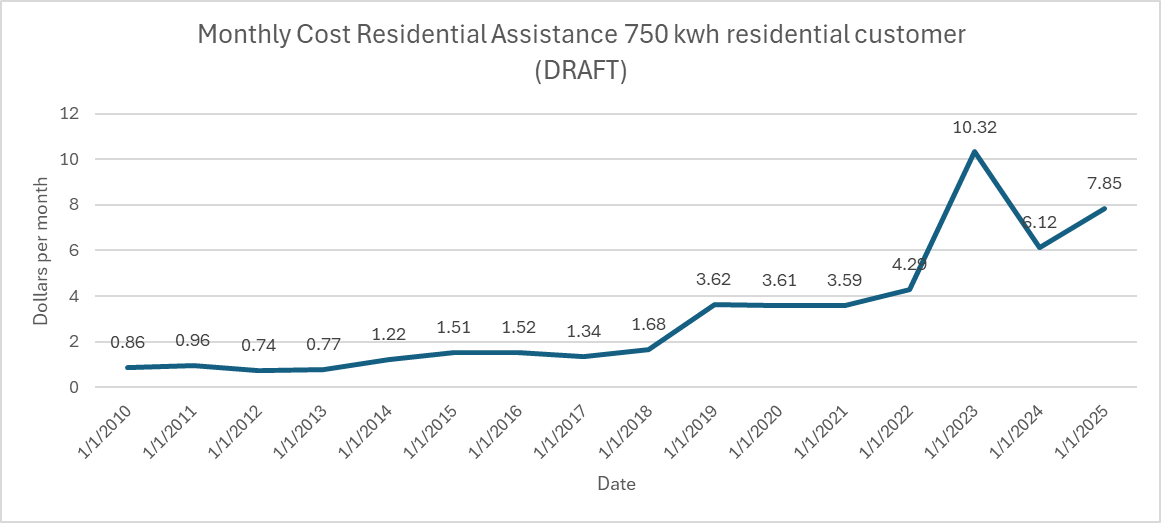
Now, to be clear, assistance for low-income ratepayers is incredibly important and necessary. Everyone in Massachusetts should be able to afford electricity – and no one is suggesting we reduce residential assistance.
But it might be time to think about how it is funded. As electricity use grows through the use of heat pumps, EVs, etc., the need for residential assistance is not only also growing – it’s growing even faster. As is the surcharge. Which shouldn’t be surprising but is concerning.
What might be surprising to some ratepayers is that solar customers don’t pay a penny into our residential assistance system. I don’t mean to pick on solar. There are complicated reasons that came to pass. But perhaps supporting needy families and seniors on fixed incomes should be paid for through the general fund (i.e., taxes) as we do for other programs.
Suffice it to say that it doesn’t make a lot of sense for one type of electricity user to be exempt from supporting the neediest ratepayers – while another pays something like $100 a year on average. Especially as costs go up, it’s something to consider.